Existing foundation
Train the teacher
Build AI competence, pedagogy and responsible practice.
Red IDAHES · European collaboration proposal
Teacher capability. Authentic learning. Skills evidence that travels across Europe.
Building on AI teacher training with K-tuin Education, IAcademia and the UCAM Chair in AI, we invite vocational education and training partners to develop the next stage together.
The opportunity
Teachers need the competence to design responsible AI-supported learning. Learners need opportunities to demonstrate vocational skills through authentic tasks.
Our European proposal connects both needs: teachers create scenarios, learners practise, and assessors build evidence that other institutions can interpret and adapt.
The same six steps as the presentation
Teacher training provides the foundation. Partners would co-design and validate the five stages that follow.
Build AI competence, pedagogy and responsible practice.
Turn a real workplace task into a teacher-reviewed scenario.
Practise decisions in an authentic vocational context.
Review performance, reasoning and communication.
Relate learning outcomes to EQF, ESCO and national standards.
Adapt reviewed scenarios across languages, sectors and countries.
Step 1 · Existing training foundation
Five modular areas combine AI foundations, data, ethics, pedagogy and professional development. Teachers work on practical outputs they can adapt to their institution.
The programme is structured around five microcredentials and an applied final project. The proposed Expert route comprises 13 ECTS for the pathway and 3 ECTS for the final project. UCAM must confirm the award, credit allocation, entry requirements and fees for each intake.
A university-specific Expert qualification is distinct from an official university degree. Recognition by another institution or country depends on its own rules.
Workshops, case studies and collaborative tasks lead to teaching resources, assessment rubrics and institutional protocols. Teachers retain pedagogical responsibility and review AI outputs.
Explore an individual microcredential area or a broader institutional pathway with training, community support and mentoring. Scope, delivery language, calendar and academic conditions are agreed before enrolment.
Steps 5–6
A reference for the level of learning outcomes. The proposed pilot focuses on tasks at levels 3–6.
About the framework ↗A shared vocabulary for occupations, skills and knowledge.
About ESCO ↗The occupational requirements and assessment context of each participating country and sector.
Proposed shared library
Each reviewed scenario would include learning outcomes, teaching notes, a rubric, local adaptations and reuse permissions. Mapping to frameworks supports interpretation; it does not automatically grant a qualification or cross-border recognition.
A proposal for participating institutions
Agree partners and sectors, train the first teacher cohort and develop 15–20 prototype scenarios.
Test across countries, review evidence capture and framework mapping, and develop the library.
Publish reviewed outputs and agree reuse models, governance and maintenance.
Years run from the agreed project start. Targets, partner roles and funding remain proposals. Erasmus+ KA220 is a candidate funding route. A possible CoVE initiative would require its own scope, eligibility assessment and timetable.
Teacher capability, learner performance, consistency between assessors and the ability of another institution to adapt a scenario. Partners would agree the measures and success criteria before implementation.
The foundation behind the proposal
Educational transformation, relationships with VET providers and implementation support.
Applied AI consultancy, including expertise in healthcare, together with teacher-training methodology, course content and the online campus.
Academic rigour, a research perspective and the framework for university pathways, subject to the relevant academic approvals.
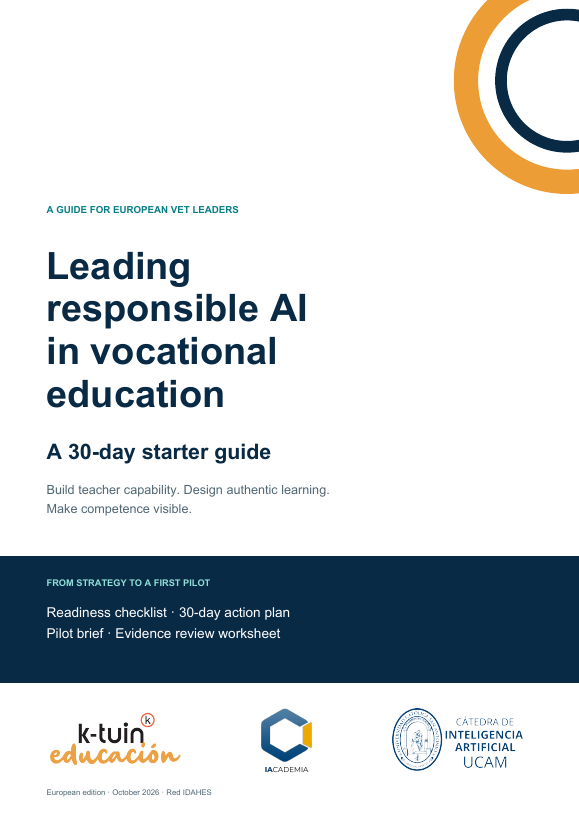
The existing 124-page leadership guide supports institutional planning and responsible AI adoption. It is currently available in Spanish.
Free guide for European VET leaders
A 30-day starter guide: from strategy to a first pilot. Build teacher capability, design authentic learning and make competence visible.
12 pages · PDF · European edition, October 2026
An invitation to the EfVET community
We invite VET pilot institutions, sector experts, assessment partners, universities and networks to explore a role in the project.
The next step is a scoping conversation: your country and sector, the learners you serve, and the contribution you would like to make.
Email the project team ↗Write to info@iacademia.es in English, mentioning “EfVET European proposal” or “Teacher training”. You can also use the existing enquiry form in Spanish.
Use this short brief to start the conversation.
The teacher-training foundation exists. The European pilots, common evidence approach, cross-border library and consortium described here are proposals for co-development and validation.
No. This is the English project overview. Delivery language, translations and local support must be confirmed for each group before enrolment.
No. Training awards follow the confirmed academic conditions. Proposed EQF and ESCO mapping helps describe learning outcomes and evidence, but recognition requires the relevant institutional or national procedures.
Teacher training is the first step. The proposed pilot builds on that foundation to develop and test vocational scenarios, assessment methods and reusable resources with participating partners.